
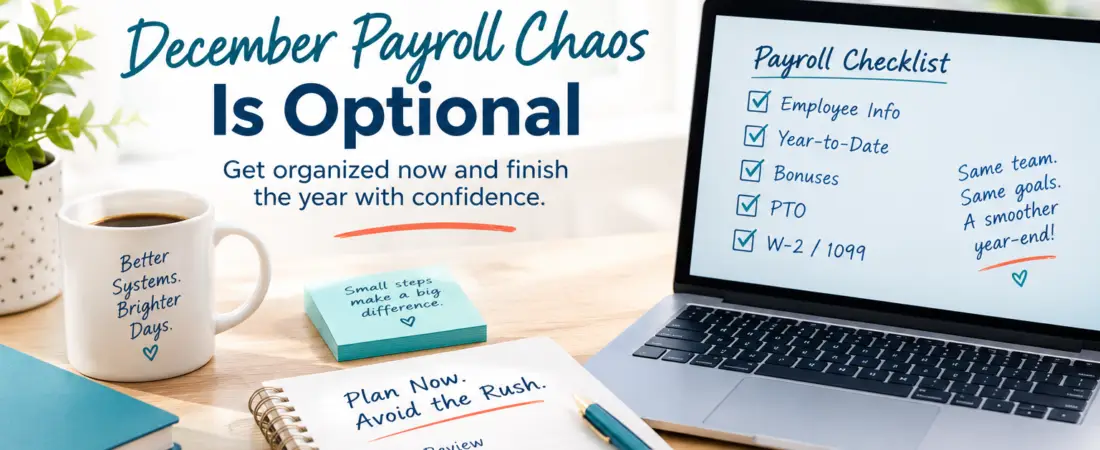
December is busy enough without payroll problems adding to the stress.
Between holiday schedules, year-end deadlines, bonuses, PTO questions, and tax reporting, it’s easy for important details to slip through the cracks. But here’s the good news: December payroll chaos is optional. Most year-end payroll headaches can be reduced with a little preparation now. Taking time to review your records, reconcile your, and map out upcoming deadlines can save you hours of scrambling later.
Here are five things you can do now to finish the year strong.
- Verify Employee Information Now
Before you get too deep into year-end payroll, make sure your employee information is accurate and up to date. Review names, mailing addresses, tax withholding elections, employment status, and other information needed for payroll and year-end reporting. Pay special attention to recent hires, terminated employees, and anyone who has reported a change. Incorrect information can lead to returned tax forms, reporting corrections, and unnecessary follow-up after the new year begins.
Don’t wait until W-2s are being prepared to discover a problem. A little data cleanup now can prevent a much bigger headache later.
- Reconcile Payroll Year-to-Date
Your payroll records should tell a consistent story across your payroll system, general ledger, and applicable tax filings.
Before the year closes, review your year-to-date wages, tax withholdings, employer taxes, deductions, and other payroll totals. Investigate discrepancies instead of assuming they’ll resolve themselves. Also check that payroll changes, adjustments, voided checks, and off-cycle payments have been recorded correctly. The goal is to identify and resolve issues while you still have time to address them. Think of this as your year-end payroll checkup. Finding an error now is much easier than trying to untangle it after year-end reporting is underway.
- Plan for Bonuses Before the Last Minute
Holiday bonuses and other year-end payments need more than a quick conversation and a last-minute payroll entry.
If bonuses are planned, confirm the amounts, approval process, payment dates, and how they will be handled through payroll. Coordinate with your finance team or payroll provider to understand the applicable tax withholding and reporting requirements. Don’t forget to account for the additional cash needed to fund the payments and any associated employer payroll taxes. If you’re offering different types of bonuses or incentives, make sure the appropriate people understand how each payment should be processed.
The earlier you plan, the fewer surprises you’ll have on payday.
- Review PTO Balances
Year-end is a great time to review paid time off balances and make sure your records are accurate.
Check for outstanding time-off requests, recent PTO usage that hasn’t been entered, and discrepancies between your HR system and payroll records. Then review your organization’s PTO policies to determine how unused balances are handled. Depending on your policy and applicable state or local requirements, unused time may carry over, be subject to limits, or require payout. Communicate any relevant year-end deadlines to employees and managers so everyone understands what action, if any, is needed.
Don’t assume your system has everything right just because the balances look familiar. Verify the numbers before closing out the year.
- Map Your W-2 and 1099 Timeline
Tax reporting deadlines should be part of your year-end plan—not a surprise waiting for you in January.
Map out the steps needed to prepare employee Forms W-2 and applicable Forms 1099. Identify who is responsible for gathering information, reviewing records, correcting discrepancies, preparing forms, and distributing or filing them. Confirm your payroll provider’s requirements and internal cutoff dates, and build in time for review and corrections. For most employers, Forms W-2 and applicable Forms 1099-NEC have a January 31 deadline for furnishing recipient copies and filing with the IRS, subject to applicable rules and calendar adjustments. Confirm the requirements for your specific forms and filing situation before finalizing your timeline.
Remember: your internal deadline should come before the official deadline. That buffer gives you room to handle unexpected issues without turning January into a scramble.
Finish the Year Organized, not Overwhelmed
Year-end payroll doesn’t have to be a fire drill.
When you verify employee information, reconcile your year-to-date totals, plan for bonuses, review PTO balances, and map your tax reporting timeline, you’re putting yourself in a much better position to close the year confidently. The secret isn’t doing everything at once. It’s knowing what needs to happen, who owns each task, and when it needs to be completed.
Need help keeping all those deadlines straight?
Check out the HR Payroll Deadline Tracker to help organize your key dates, stay on top of important tasks, and keep year-end payroll moving in the right direction.
Because a smoother year-end starts with a better system.
The Organized HR Pro — Systems. Clarity. Confidence.